
From the Boxxi kitchen · European and Japanese-inspired
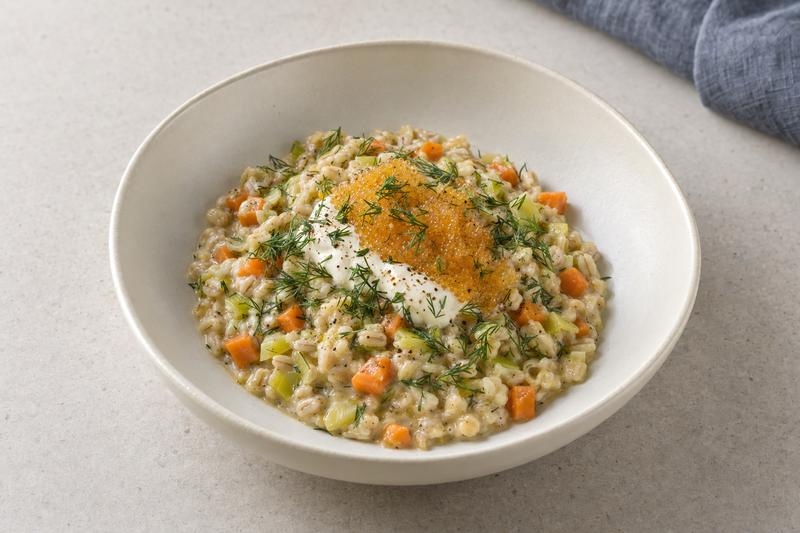
Creamy pearl barley risotto with leeks, carrots and pike roe
As pearl barley slowly cooks with leeks and carrots, it becomes a hearty, creamy dish while keeping a pleasantly firm bite. We top it with a teaspoonful of cold crème fraîche and pike roe. Dill and lemon bring a final touch of freshness.
We simmer the barley gently and briefly reduce any excess liquid at the end if needed.
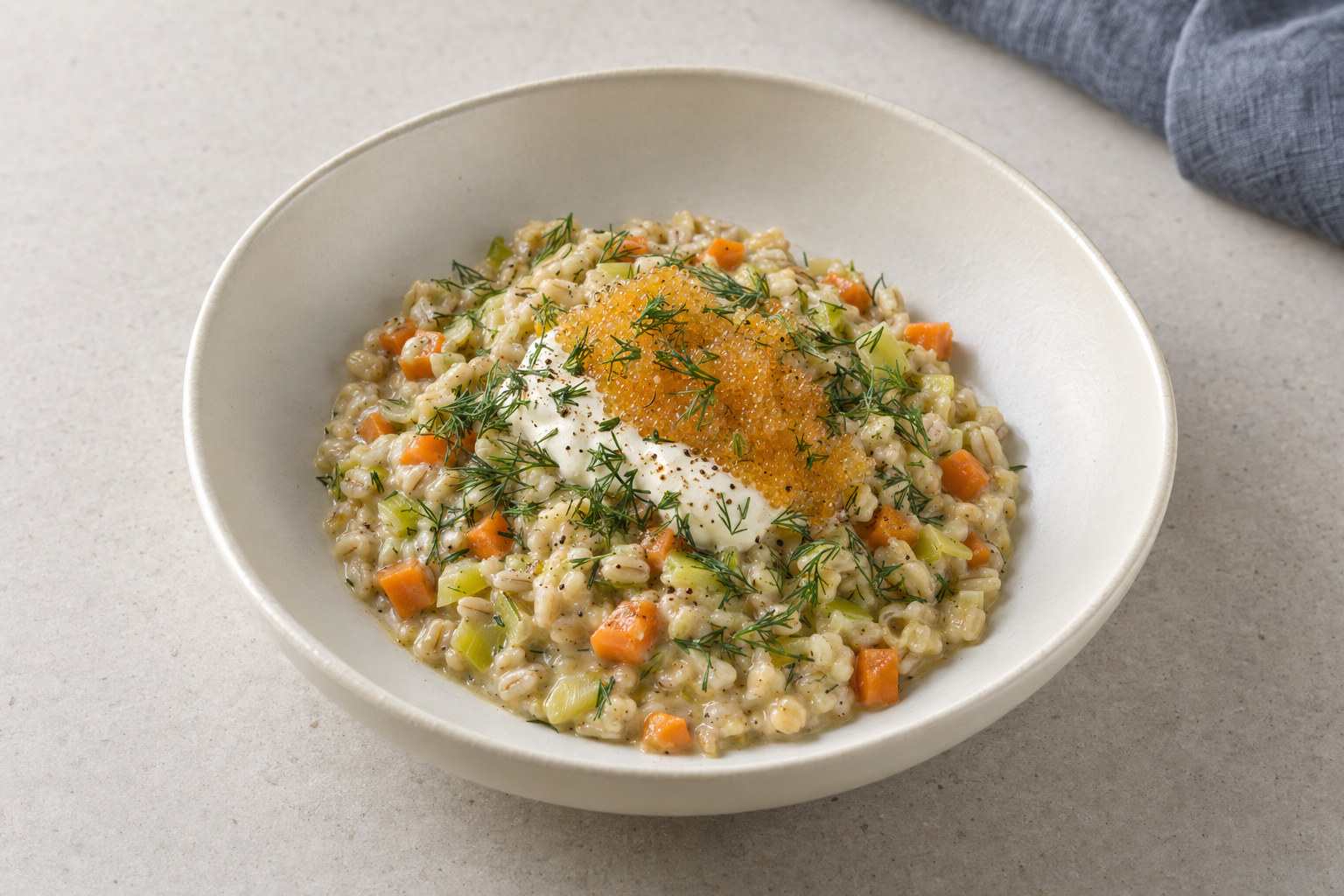
Sweet carrots and buttery leeks mellow the grain flavour of the barley. Soured cream and lemon freshen it up, while the roe adds saltiness and a delicate beaded texture.
Step-by-step method
What you will need
- kitchen scales
- knife and chopping board
- sieve
- wide 2.5 l casserole with a lid
- kettle
- spatula
Before we start
We keep the roe and reserved cream chilled until the final step; everything else cooks in one casserole.
Prepare the base
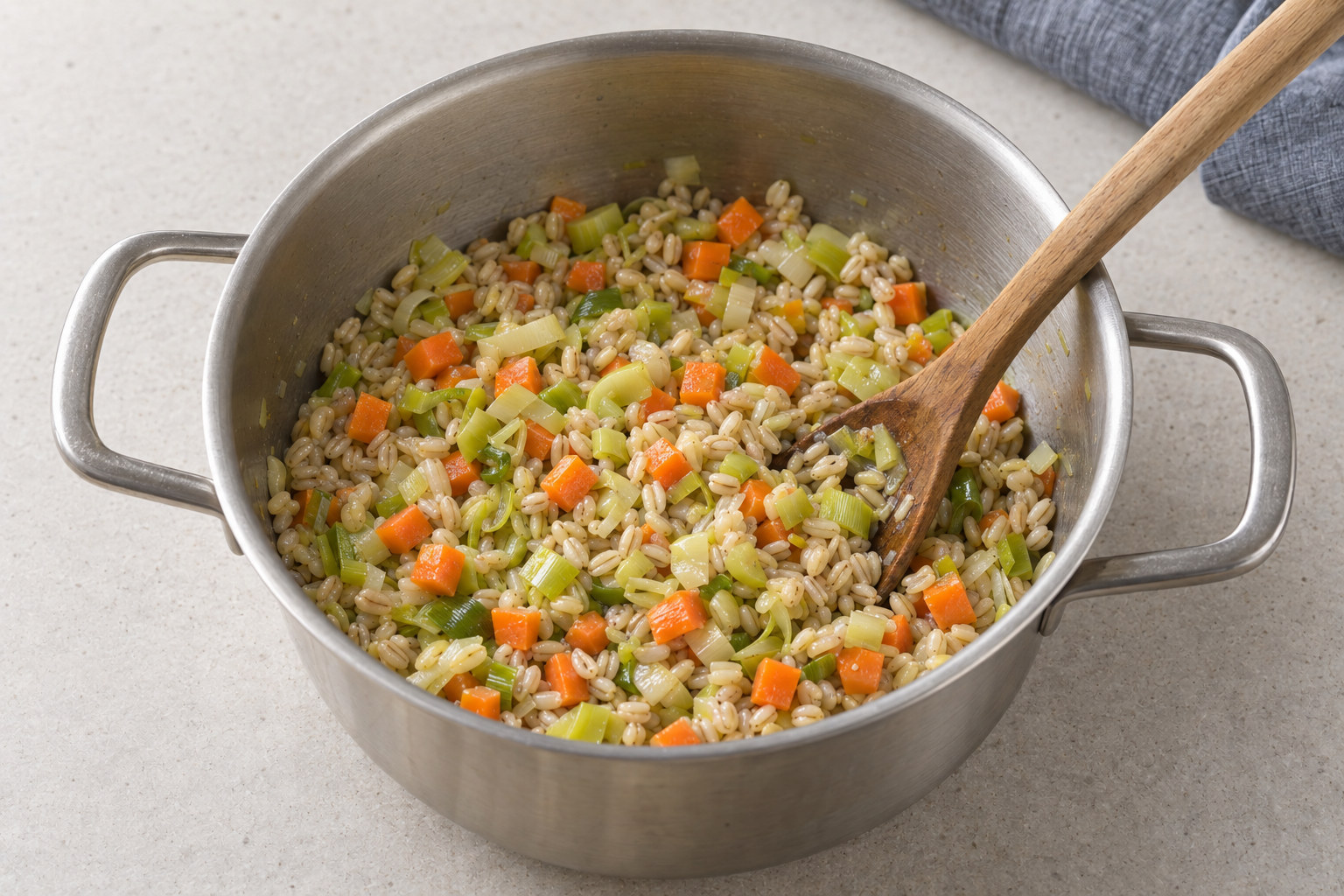
We rinse the barley in a sieve under cold running water and leave to drain. We split the leek lengthways and rinse between its layers. We peel the carrots. We cut the leek into half-centimetre half-rings and the carrots into half-centimetre cubes. In a wide 2.5 l casserole, we gently soften the leek and carrots in the butter for 5 minutes. We add the barley and stir for another minute.
The vegetables are glossy with no dark, burnt edges, and the barley is coated in butter.
Cook the barley
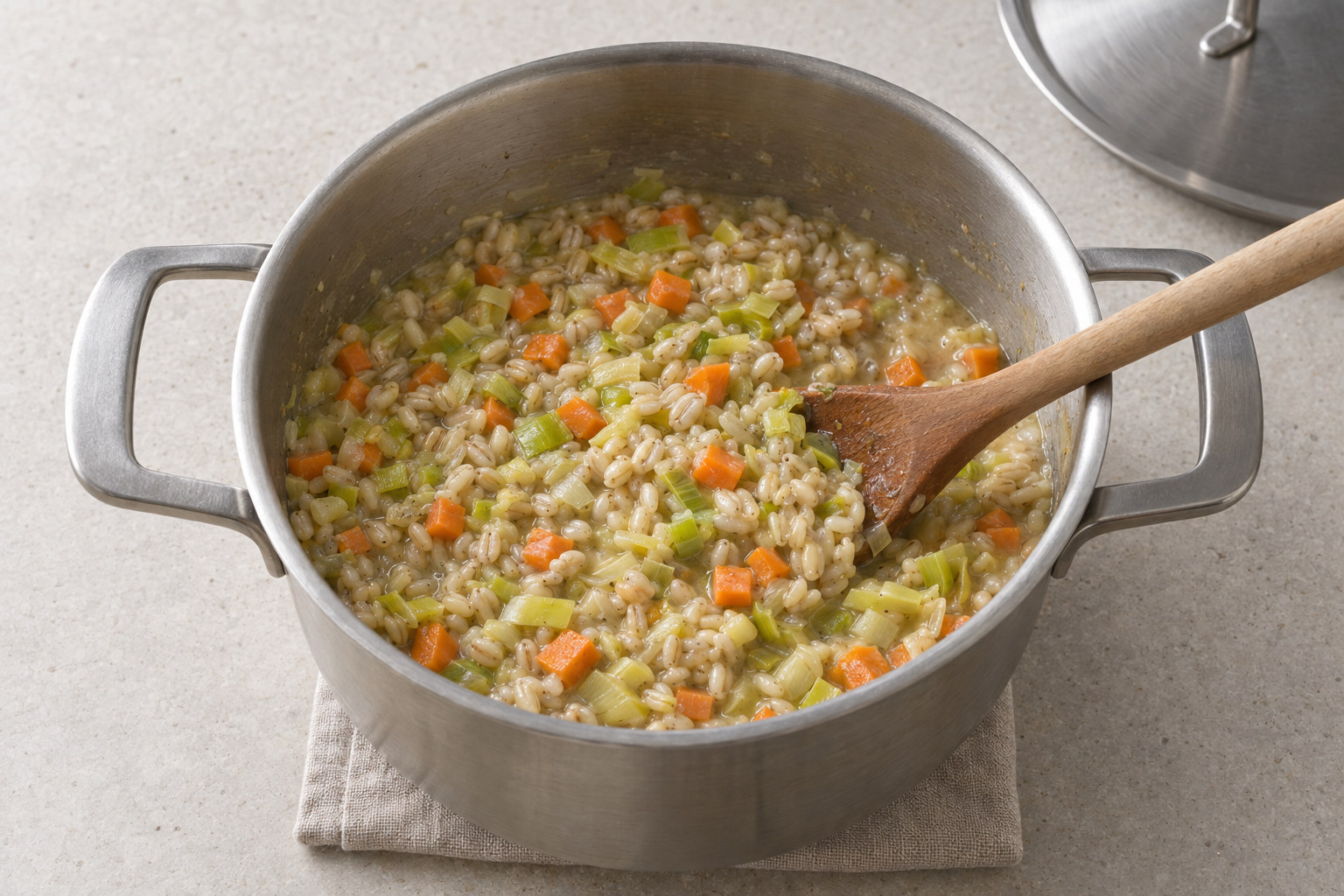
We pour in 550 ml stock, add ¼ teaspoon of salt, bring to the boil and simmer gently under a partly open lid for 35–45 minutes. We stir every 5 minutes, reaching the bottom. We heat the 150 ml reserved water in the kettle and add it in 30 ml amounts only if the liquid is disappearing before the barley is tender; we do not add any unused remainder. If the barley is already tender and plenty of liquid remains, we remove the lid and reduce for another 3–5 minutes, stirring.
The barley is tender inside but pleasantly firm to the bite. A little creamy liquid remains at the end, rather than a soup.
Make it creamy and season
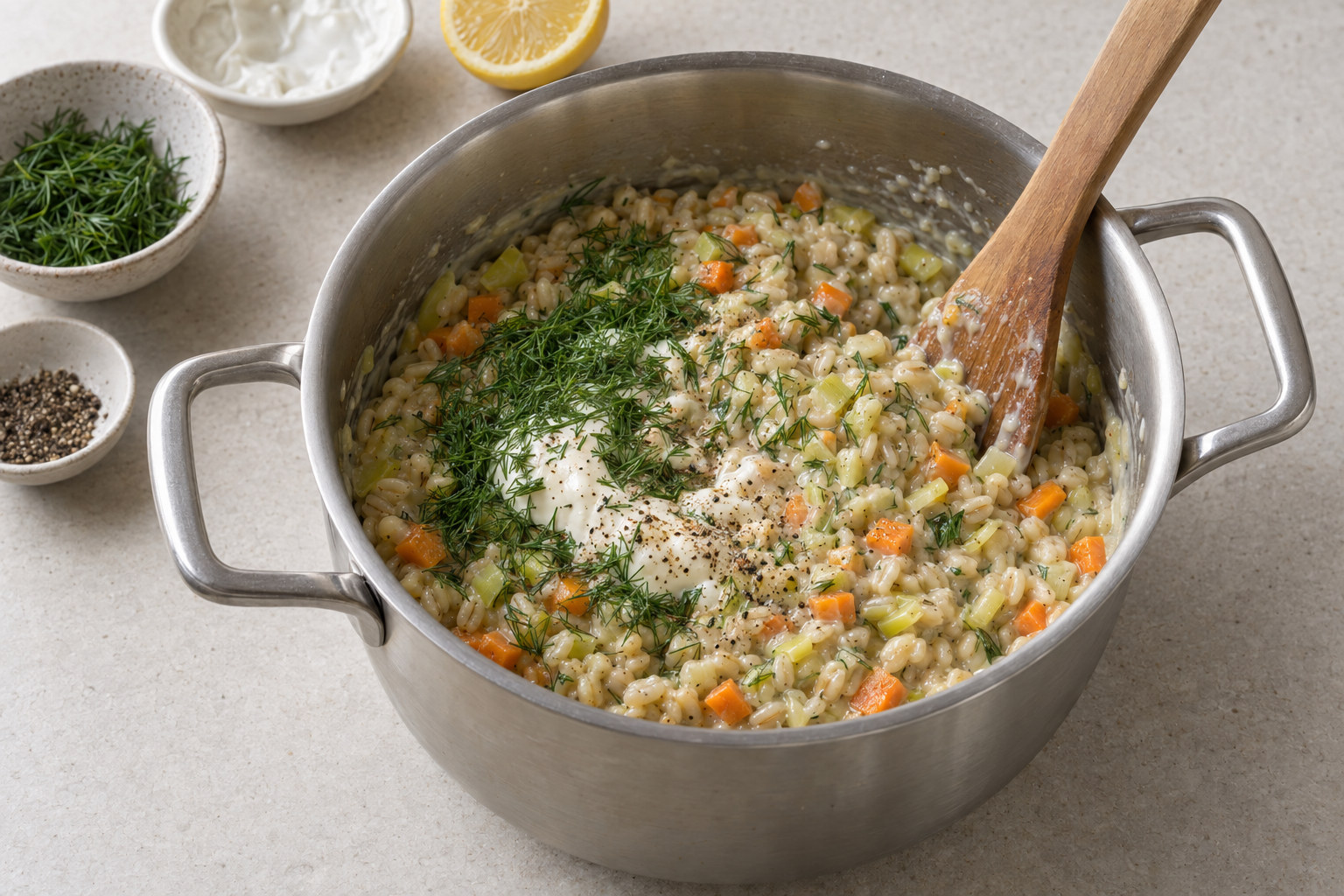
We wash, dry and chop the dill. We stir 40 g crème fraîche, the lemon juice, pepper and most of the dill into the cooked barley, keeping the remaining dill for the top. We take it off the heat for 1 minute. If the mixture is too thick to flow, we add the remaining warm water a tablespoon at a time, using no more than the prepared 150 ml water in total.
The barley risotto flows slowly when we tilt the casserole; it must be neither dry nor watery.
Serve with roe
We divide the barley risotto between two deep plates. We share the remaining cold crème fraîche between them, then place the roe and remaining dill on top. We serve straight away, without stirring the roe into the hot barley.
The cold cream separates the delicate roe from the hot surface, keeping the beads intact.
Tips from our kitchen
- We choose pearl barley; barley with a different degree of polishing may need longer to cook.
What to watch out for
- We do not replace unsalted stock with concentrated salty bouillon without adjusting the salt.
- The finished barley risotto thickens as it stands, so we serve it immediately.
How we serve it
- We divide the barley risotto between deep plates. We top it with cold crème fraîche, add pike roe and dill and serve straight away.
Ingredient notes
- We place the tiny golden-yellow pike roe on cold crème fraîche to keep it from touching the hot barley risotto directly.
During preparation
- We keep the roe chilled at 0–4 °C as directed on the packaging and use a clean spoon to serve it. It is ready to eat; we add it only at the end and do not cook it. We store any remainder from the opened pack separately, following the manufacturer’s instructions.
Our inspiration
Barley gives a creamy dish a different bite from rice: even when tender, it stays pleasantly firm. For this barley risotto, we pour in the stock all at once and leave it to simmer with leeks and carrots. On the plate, the hot grain meets cold cream and tiny roe. We scoop up a little of the creamy topping with each mouthful to bring both flavours together.
Similar recipes


Recipe for 4 people
We allow time to heat the larger quantity and reduce any excess liquid at the end.
Step-by-step method
Before we start
We keep the reserved water hot in the kettle and add it according to how much liquid evaporates and whether the barley is tender. We may not need it all.
Prepare the base
We rinse and drain the barley. We split the leek lengthways and rinse between its layers. We peel the carrots. We cut the leek into half-centimetre half-rings and the carrots into half-centimetre cubes. In a wide 4 l casserole, we gently soften them in the butter for 7 minutes. We add the barley and stir for 1 minute.
The vegetables are glossy with no dark, burnt edges, and the barley is coated in butter.
Cook the barley
We pour in 950 ml stock, season with a quarter of a teaspoon of salt and simmer gently under a partly open lid for 40–50 minutes. We stir regularly, reaching the bottom. We heat the 250 ml reserved water in the kettle and add it in 40–50 ml amounts as liquid evaporates. We may not need all the water. If the barley is tender but the mixture is still loose, we remove the lid and reduce for 3–5 minutes.
The barley is tender inside but pleasantly firm to the bite. A little creamy liquid remains at the end, rather than a soup.
Make it creamy and season
We wash, dry and chop the dill. We stir in 60 g crème fraîche, the lemon juice, pepper and most of the dill, keeping a little for finishing. We take the casserole off the heat for a minute and, if needed, loosen with a few tablespoons of the remaining warm water reserved for topping up. We add no more salt.
The barley risotto flows slowly when we tilt the casserole; it must be neither dry nor watery.
Serve with roe
We divide the barley risotto between four plates. Using a spoon, we divide the remaining 40 g cold crème fraîche into four portions, place one on each plate of barley and top with the roe and reserved dill. We serve straight away.
The cold cream separates the delicate roe from the hot surface, keeping the beads intact.