
Boxxi signature cuisine · European inspiration
Bone-in rib-eye with rösti and horseradish cucumber
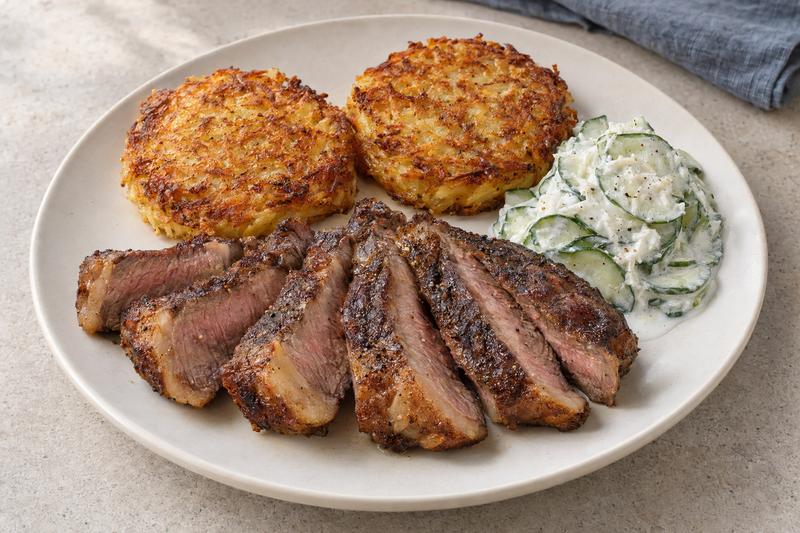
We serve juicy slices of rib-eye with two small rösti, crisp and golden on the outside. Cold cucumber in yoghurt with fresh horseradish adds a bite that works well with the rich beef and fried potatoes.
The estimate includes both rounds of the initial rösti frying, 28–32 minutes in total. We crisp them again for 4 minutes during the 15-minute meat rest. For a whole piece thicker than 7 cm, we allow another 20–35 minutes according to the probe. For staggered serving, we prepare meat and sides alongside each other. Finishing another part of the side separately can add 10–15 minutes of active work; we do not leave cooked meat waiting for it. Meat cooking times are guides only and vary with thickness and desired doneness. We rely on repeated probe readings.
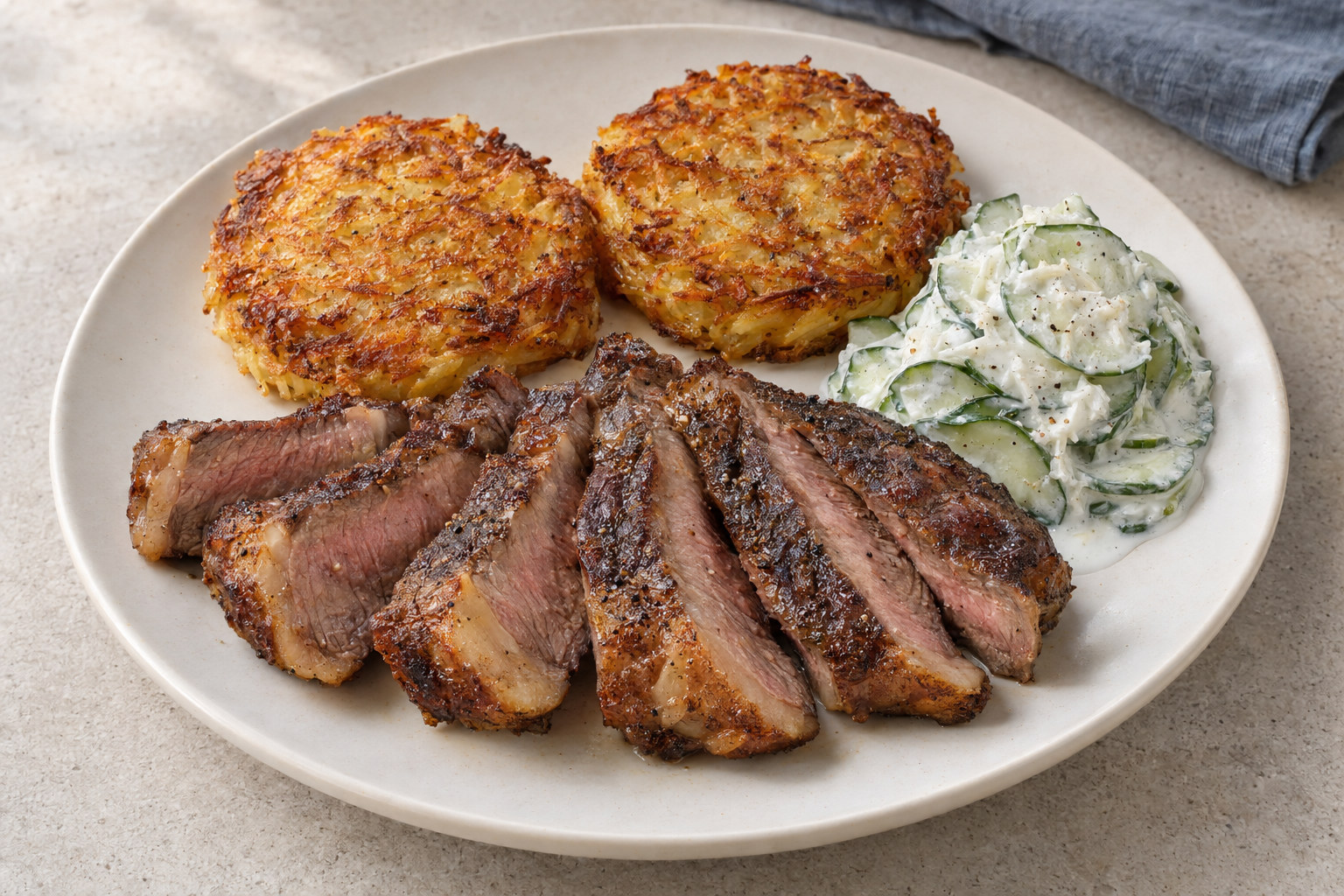
Golden potato crust and pungent horseradish balance the richer meat; yoghurt lightens the accompaniment.
Step-by-step method
What you will need
- kitchen scales
- knife, clean board and tongs
- thin probe thermometer
- conventional oven and one 40 × 30 cm tray with a rack
- two heavy pans with flat bases at least 24 cm across; for 1000 g Chianina, also one wide 30 × 30 cm griddle
- heatproof plate and foil; the meat must fit flat on both rack and pan without overlapping
- one auxiliary 28 cm pan with a lid and a 24 cm flat base
- coarse grater, clean tea towel and rack
- 3 hob rings
- 2 deep heatproof dinner plates and oven gloves
- electric kettle of at least 1.7 l and a clean tea towel
- one 40 × 30 cm tray with a rack for four rösti arranged 2 × 2
- shallow metal dish to hold the side in a layer no deeper than 2 cm
Choosing how well to cook your steak
Before cooking, we choose how well we would like our meat done. This guide describes culinary levels of doneness and approximate temperatures at the centre of the meat after resting. These are not pan or oven temperatures or food safety recommendations. For whole beef steaks, the United States Department of Agriculture (USDA) recommends a minimum internal temperature of 63 °C before removing the meat from the heat, followed by at least 3 minutes of resting.
| Doneness | Temperature after resting | What to expect |
|---|---|---|
| Rare | 52 °C | Rare. The centre is red, and the meat is very tender and juicy. |
| Medium Rare | 55 °C | Medium rare. The centre is warm and reddish-pink, and the meat is tender and juicy. |
| Medium | 60 °C | Medium. The centre remains pink, and the meat has a firmer bite. |
| Medium Well | 65 °C | Medium well. Only a faint pink strip remains in the centre; the meat is firmer and less juicy. |
| Well Done | 71 °C | Well done. There is no pink in the centre, and the meat is firm and less juicy. |
- We measure the temperature at the centre of the thickest part of the meat. We insert the probe from the side, avoiding bone and pockets of fat. Colour is only a guide; we rely on the thermometer.
- As a rule, we take the meat off the pan or grill, or out of the oven, when it is 2–3 °C below our chosen temperature after resting. Thick cuts and intense heat can cause a greater temperature rise during resting. We check it regularly and follow the individual recipe.
- We rest the meat for the time given in the recipe. If the temperature stops rising before reaching our chosen value, we briefly return the meat to a gentle heat and check again.
- Cooking times are a guide. If we prefer our meat less well done, we start checking its temperature earlier. For a higher degree of doneness, we allow more time over a gentler heat as needed, so the outside does not burn.
Before we start
We prepare the horseradish cucumber in advance and chill it. For thin meat, we make the rösti first. For meat thicker than 3 cm and up to 5 cm, we start preparing the rösti as soon as the meat goes into the oven; for thicker meat, we start during gentle roasting according to the probe reading. We rest the meat outside the oven and briefly re-crisp the potatoes during its 15-minute rest. We can serve completed portions one after another. We compare the thickness of all pieces beforehand. If they differ by more than 1 cm or we choose different doneness levels, we plan to serve complete portions in stages; even pieces of similar thickness may not be ready together. We share one 1000 g rib-eye between two people, while one 500 g rib-eye makes one generous serving.
We prepare the meat and cucumber
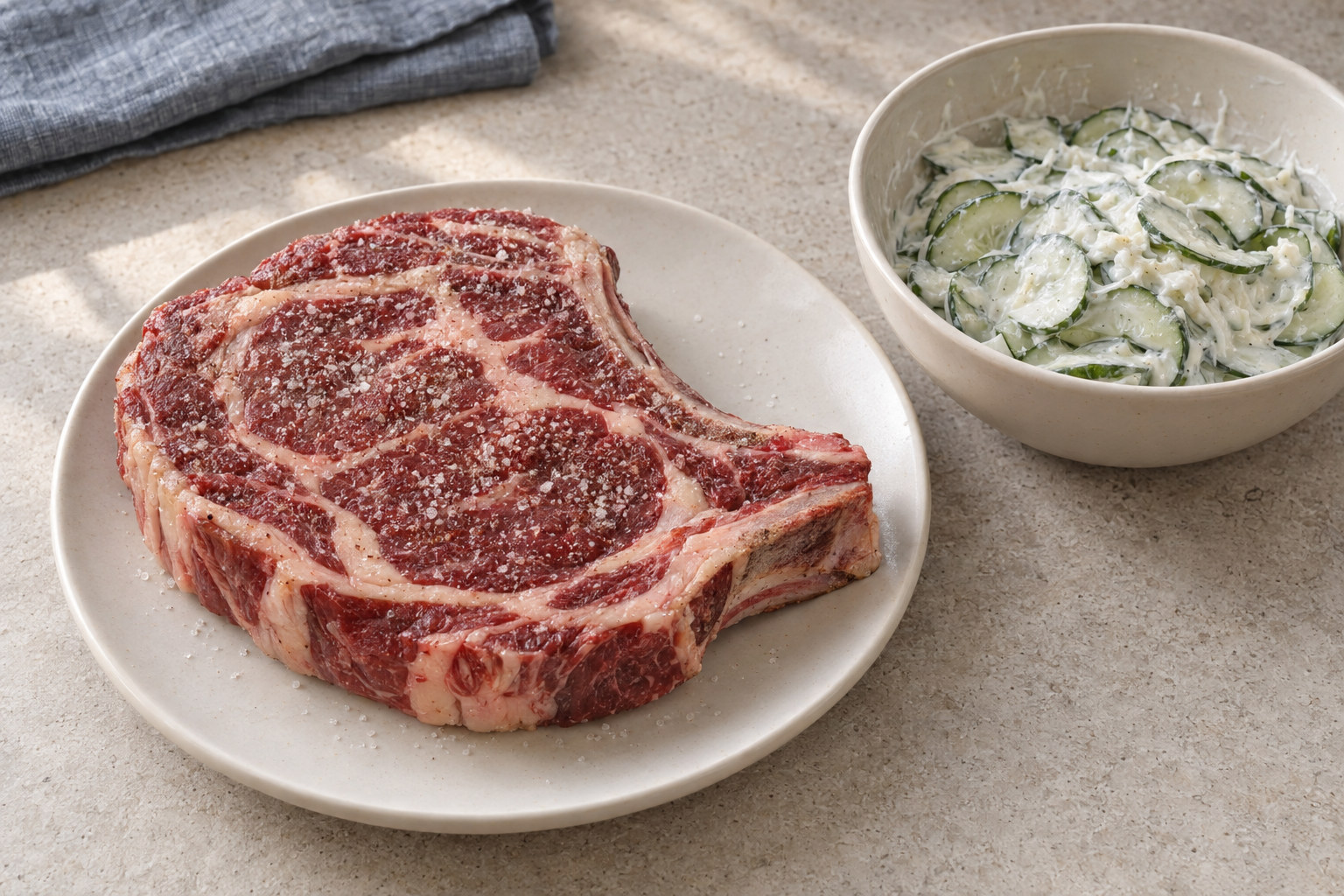
We choose the meat doneness using the guide above the method. We use one whole 1000 g Chianina rib-eye to share between two, or choose two whole 500 g Ayrshire rib-eyes. The total weight is the same, but the number of pieces and final searing differ. We pat the meat dry, season it with 1 tsp salt in total and the pepper set aside for the meat, cover and leave in the fridge for now. We identify the main rib-eye muscle and the surrounding cap separated by fat. We do not judge cooking time by marbling. We peel and grate the horseradish. We wash and halve the cucumber lengthways, slice it into thin half-moons and toss with yoghurt, horseradish, 10 ml lemon juice and a pinch of salt. We cover and chill it. We leave the potatoes whole for now. For meat thicker than 3 cm and up to 5 cm, we peel and wash them before putting the meat in the oven, but grate them only in step 3. We warm the serving plates before serving and prepare a separate lukewarm plate for resting the meat.
We do not salt and squeeze the cucumber separately; its juices belong in the dressing.
We gently roast the thicker steaks
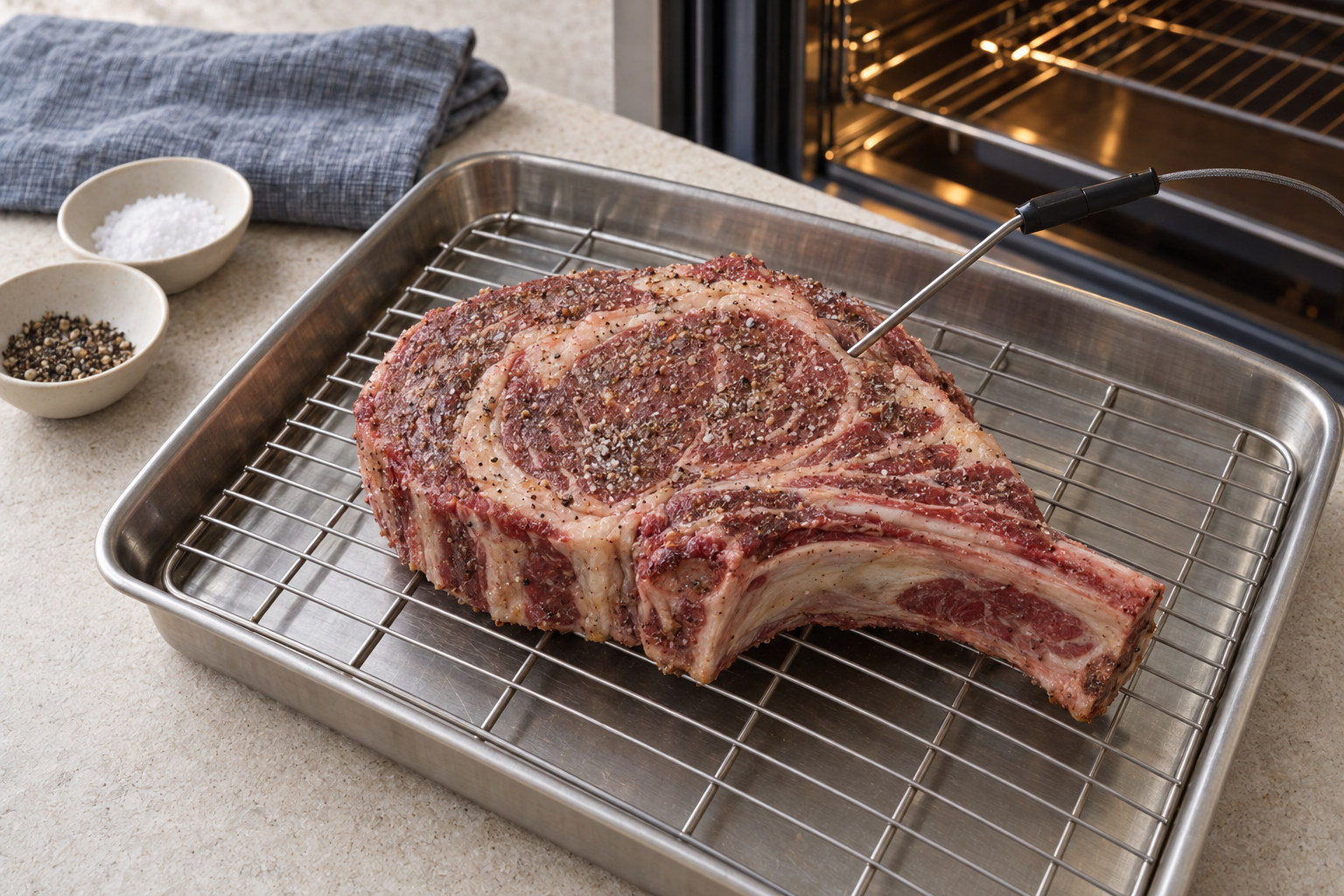
For meat no thicker than 3 cm, we skip gentle roasting. We first make all the rösti in step 3, hold them covered in an oven heated to 75 °C, then sear the meat as in step 4. For thicker pieces, we preheat the conventional oven to 120 °C. We set the meat on a rack over a tray, leaving space around and between either the one 1000 g piece or the two 500 g pieces. Times of 30–55 minutes for thickness over 3 cm and up to 5 cm and 50–80 minutes for 5–7 cm are guides. We watch the temperature from the start, as meat intended for lower doneness may be ready for the pan earlier. We remove the meat from the oven when its centre is about 8–10 °C below the chosen post-rest target, leaving room for pan-searing the crust. For rare, this is about 42–44 °C. We insert the probe from the side into the centre of the thickest part, avoiding bone and fat seam; we also check the separate thicker muscles of the rib-eye. We check each piece separately. We keep any piece thicker than 7 cm whole and bone-in and allow another 20–35 minutes of gentle roasting. Near the removal temperature, we check the centre at intervals no longer than 5 minutes, more often just before reaching it. We measure each piece separately. The first piece ready may wait on a rack outside the oven for no more than 10 minutes before searing. If the others need much longer, we sear it, rest it and serve with its share of sides while the others continue roasting at 120 °C. For meat thicker than 3 cm and up to 5 cm, we move straight to preparing the rösti in step 3 after putting it in the oven.
We shape and fry the rösti
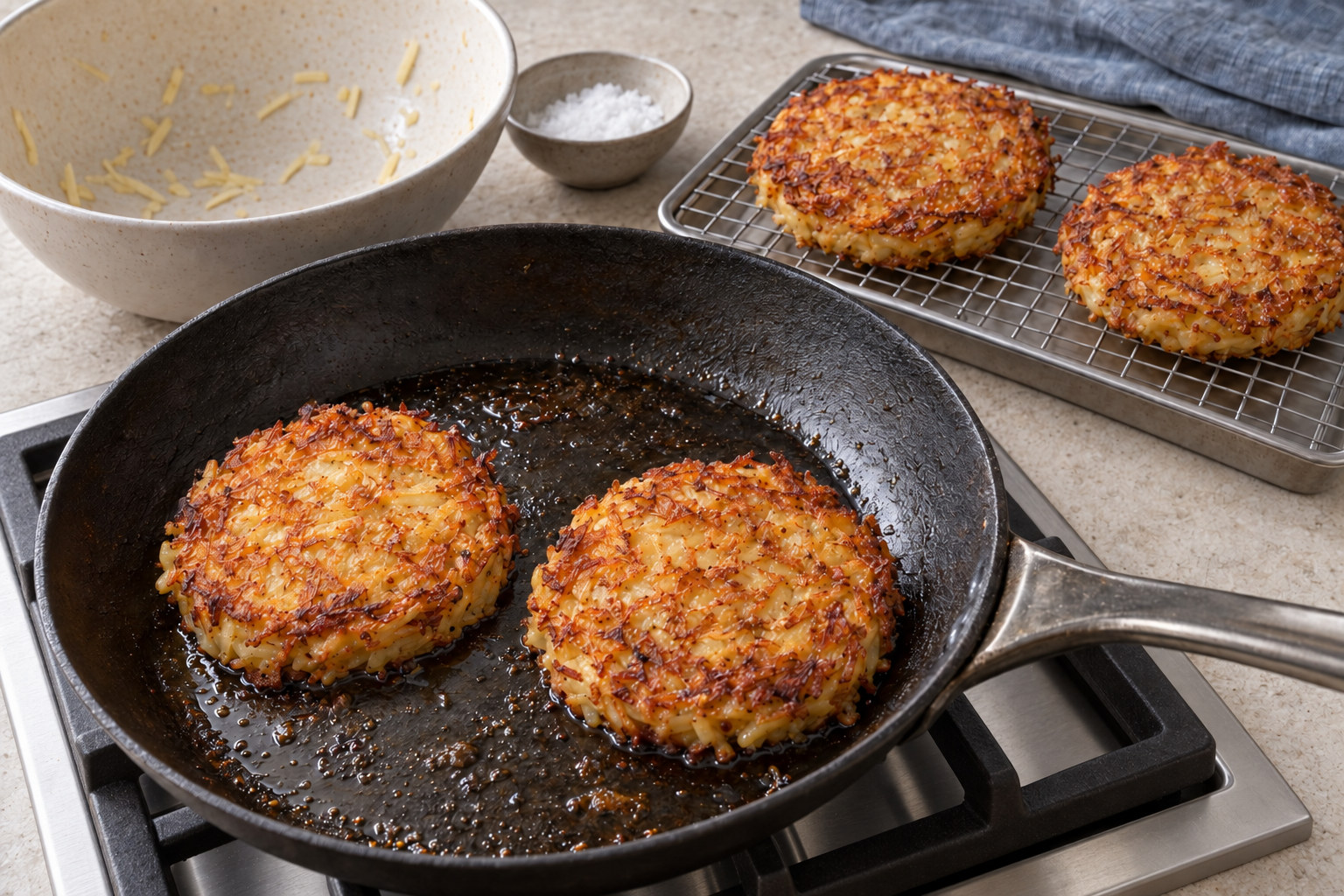
For meat thicker than 3 cm and up to 5 cm, we start preparing the rösti as soon as the meat goes into the oven. For pieces over 5 cm, we start when the centre of the fastest-heating piece is about 25 °C below the chosen post-rest target. For thin pieces up to 3 cm, we finish both rösti batches before searing the meat. If we have not already done so, we peel and wash the potatoes. We coarsely grate them, squeeze them briefly in a clean tea towel, and only then mix with 0.25 tsp salt. We divide all the squeezed potato into four equal portions and shape cakes 11 cm across and about 1–1.2 cm thick. In one auxiliary 28 cm pan, we fry them in two batches of two. We reserve 0.5 tbsp fat for the end and divide the rest between the initial batches. We fry the first side for 7–8 minutes on a medium heat, with the lid on for the first 3 minutes, and the second side uncovered for 7–8 minutes. The centres must be tender and fully cooked. We set the first batch on a rack. If the meat reaches the oven removal temperature before we finish the rösti, we rest it on a rack outside the oven for no more than 10 minutes. We recheck its temperature before searing and adjust pan time to our chosen doneness while finishing the rösti in the auxiliary pan. If the rösti need longer, we start searing the meat in the main pan and finish the rösti in the auxiliary pan while the meat sears and rests. If the rösti finish first, we keep them covered outside the oven for no more than 20 minutes. Only when no meat remains in the oven do we set it to 75 °C after removing the meat for searing, verify the actual temperature and put the cooked rösti inside beneath loose foil. For staggered service, we keep slower meat in the oven at 120 °C. We set the cooked rösti for the first serving on a rack for no more than 20 minutes and finish them in the freed-up pan while the meat rests. We store the remaining rösti as described in the final step. We do the same if potatoes for even a single piece of meat would wait longer than the stated limit.
The two rounds of initial frying take 28–32 minutes in total. All the rösti have soft, fully cooked centres.
We finish the meat and let it rest
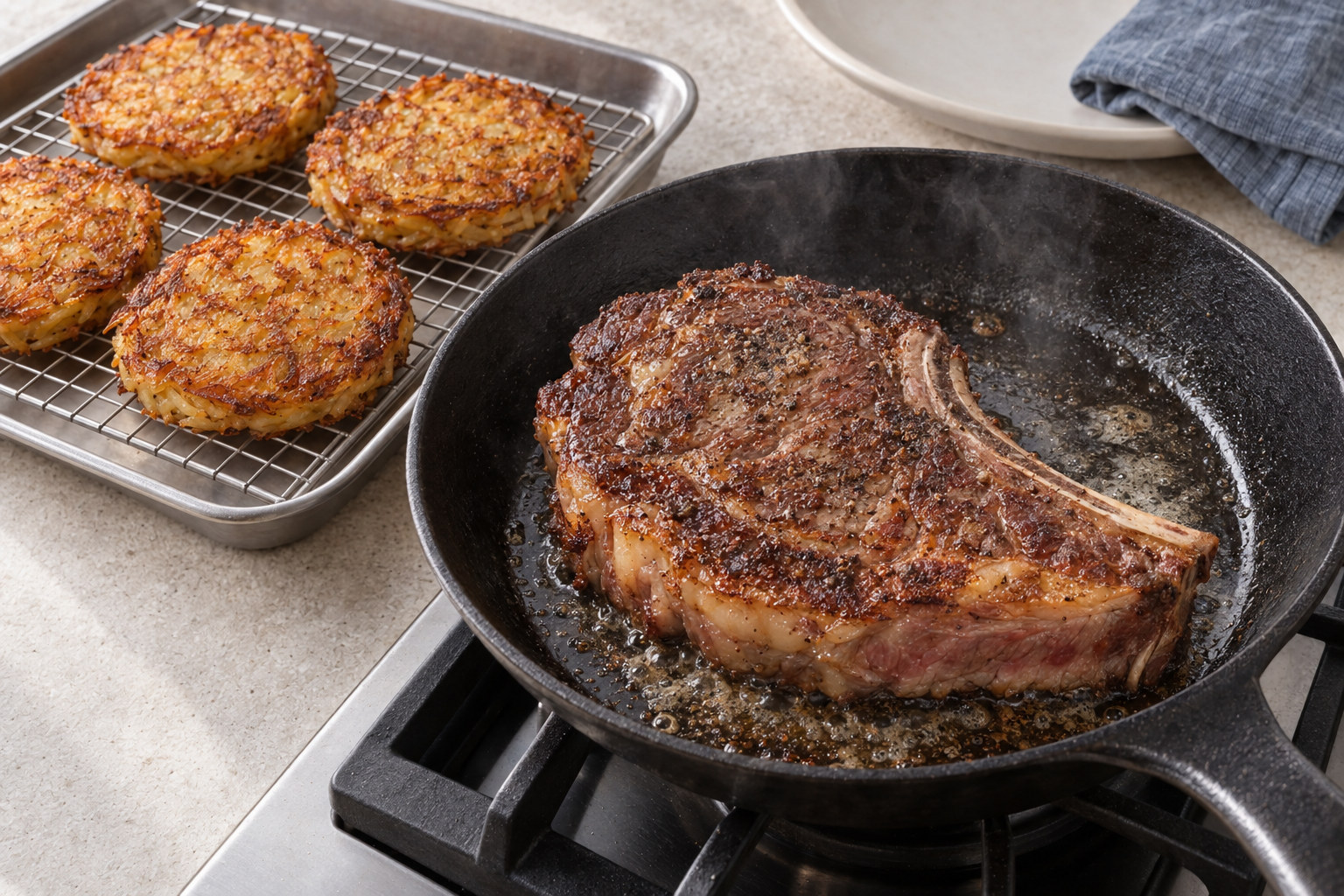
For the basic 1000 g Chianina, we heat one wide griddle; for two 500 g pieces, we heat two pans. We divide the meat oil between the pans and batches used. We sear the meat for roughly 2 minutes on each broad side and press the fleshy edges against the pan with tongs for 30 seconds. We measure each piece after the first turn and may shorten the searing of sides and edges according to the probe. Once a crust forms, we lower the heat and keep turning every minute as needed. We usually take the meat off the heat when its centre is 2–3 °C below the chosen post-rest target. A large thick piece may rise further, so we monitor the probe and remove it earlier if the temperature trend warrants. We use 6–10 final minutes after gentle roasting and 10–18 minutes total for thin raw steaks that skipped the oven only as guides. For greater doneness, we continue gently as needed; for less, we stop sooner. We rest each cooked piece for 15 minutes on the prepared lukewarm plate outside the oven, loosely covered. We watch how far its temperature rises. If it does not reach the chosen doneness after resting, we briefly cook it further over gentle heat. Only if no meat remains in the oven do we keep cooked rösti there at 75 °C for no more than 45 minutes including service; we also watch this limit for the thin-meat option, where we make rösti first. If the meat needs more time, we store and reheat the remaining rösti once as in the final step.
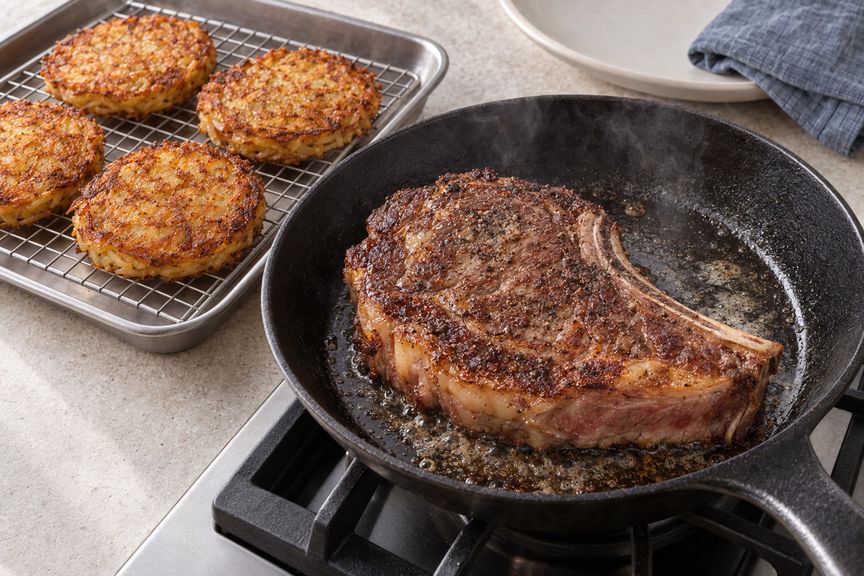
We crisp the rösti again and serve with the meat
While the meat rests, we re-crisp all the rösti in one round on two freed-up surfaces, two on each. For Chianina, we use the main wide griddle and auxiliary pan; for two 500 g pieces, both main pans. We divide the reserved 0.5 tbsp fat between them and fry each side for 2 minutes. We cut the meat from the bone, slice it and divide between two plates. We add two rösti and the cucumber with horseradish yoghurt to each. For staggered service, we re-crisp only two rösti for the serving going out. If the other meat needs longer, we do not leave its rösti in the oven too long after the first frying. We let them steam off on a rack for 10 minutes, then cover and refrigerate no later than 1 hour after cooking. While the next piece of meat rests, we reheat them in a freed-up pan over gentle heat for 4–5 minutes on each side, with the lid on for the first side. After removing the lid, we fry them a little longer if needed until crisp outside and hot in the centre. We use the fat set aside for finishing for this single reheating.
We serve the potatoes hot with their crust restored, and the cucumber fresh and cold.
Tips from our kitchen
- We add salt only after squeezing the potatoes and fry the rösti straight away.
What to watch out for
- We do not measure temperature in the bone or the fat seam.
- We do not stack the steaks or overcrowd the pan. We follow the stated number of batches.
How we serve it
- For each serving, we divide up the sliced meat removed from the bone, two rösti and cucumber with horseradish yoghurt. We serve the potatoes hot and the cucumber cold.
Ingredient swaps
fresh horseradish
the same weight of unsweetened finely grated jarred horseradish We check the ingredients in the jarred horseradish. We first add only half the salt set aside for the cucumber, then taste after adding the horseradish.
Ingredient notes
- We use a 1000 g Chianina rib-eye and share one piece between two. Before cooking, we measure its thickness and check that it fits the pan.
- We use a 500 g bone-in Ayrshire rib-eye, one generous steak per person. Before cooking, we measure its thickness and check that it fits the pan.
During preparation
- We use clean utensils for both raw and cooked meat. For now we leave the meat in the fridge.
- We check the temperature of each piece with a probe in the centre of the thickest meat, away from the bone and fat seam. We also measure the separate thicker muscles of the rib-eye.
Our inspiration
We do not need to pre-cook the potatoes for rösti. This Swiss speciality can also be made as a cake of raw grated potato: we cook it partly under a lid, then brown it uncovered. We use a similar method for our smaller rösti with rib-eye. They contain only grated potato, so no flour batter masks their taste or crust.
Similar recipes
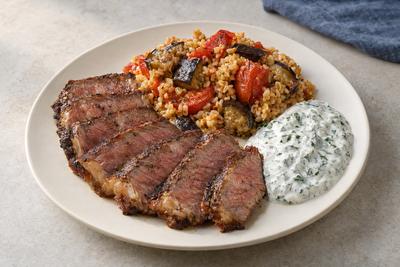
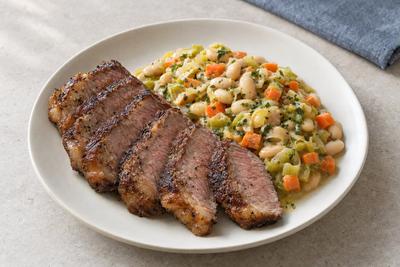
Recipe for 4 people
The estimate includes two simultaneous rounds of initial rösti frying, 28–32 minutes in total, and final crisping in two 4-minute rounds. We cook four thin 500 g pieces at once in four pans. For a whole piece thicker than 7 cm, we allow another 20–35 minutes according to the probe. For staggered serving, we prepare meat and sides alongside each other. Finishing another part of the side separately can add 10–15 minutes of active work; we do not leave cooked meat waiting for it. Meat cooking times are guides only and vary with thickness and desired doneness. We rely on repeated probe readings.
Step-by-step method
Choosing how well to cook your steak
Before cooking, we choose how well we would like our meat done. This guide describes culinary levels of doneness and approximate temperatures at the centre of the meat after resting. These are not pan or oven temperatures or food safety recommendations. For whole beef steaks, the United States Department of Agriculture (USDA) recommends a minimum internal temperature of 63 °C before removing the meat from the heat, followed by at least 3 minutes of resting.
| Doneness | Temperature after resting | What to expect |
|---|---|---|
| Rare | 52 °C | Rare. The centre is red, and the meat is very tender and juicy. |
| Medium Rare | 55 °C | Medium rare. The centre is warm and reddish-pink, and the meat is tender and juicy. |
| Medium | 60 °C | Medium. The centre remains pink, and the meat has a firmer bite. |
| Medium Well | 65 °C | Medium well. Only a faint pink strip remains in the centre; the meat is firmer and less juicy. |
| Well Done | 71 °C | Well done. There is no pink in the centre, and the meat is firm and less juicy. |
- We measure the temperature at the centre of the thickest part of the meat. We insert the probe from the side, avoiding bone and pockets of fat. Colour is only a guide; we rely on the thermometer.
- As a rule, we take the meat off the pan or grill, or out of the oven, when it is 2–3 °C below our chosen temperature after resting. Thick cuts and intense heat can cause a greater temperature rise during resting. We check it regularly and follow the individual recipe.
- We rest the meat for the time given in the recipe. If the temperature stops rising before reaching our chosen value, we briefly return the meat to a gentle heat and check again.
- Cooking times are a guide. If we prefer our meat less well done, we start checking its temperature earlier. For a higher degree of doneness, we allow more time over a gentler heat as needed, so the outside does not burn.
Before we start
We prepare the horseradish cucumber in advance and chill it. For thin meat, we make the rösti first. For meat thicker than 3 cm and up to 5 cm, we start preparing the rösti as soon as the meat goes into the oven; for thicker meat, we start during gentle roasting according to the probe reading. We rest the meat outside the oven and briefly re-crisp the potatoes during its 15-minute rest. We can serve completed portions one after another. We compare the thickness of all pieces beforehand. If they differ by more than 1 cm or we choose different doneness levels, we plan to serve complete portions in stages; even pieces of similar thickness may not be ready together. We share one 1000 g rib-eye between two people, while one 500 g rib-eye makes one generous serving.
We prepare the meat and cucumber
We choose the meat doneness using the guide above the method. We use two whole 1000 g Chianina rib-eyes, each shared between two people, or choose four whole 500 g Ayrshire rib-eyes. The total weight is the same, but the number of pieces and final searing differ. We pat the meat dry, add the salt and pepper set aside for it, cover and leave it in the fridge for now. We identify the main rib-eye muscle and the surrounding cap separated by fat. We do not judge cooking time by marbling. We peel and grate the horseradish. We wash and halve the cucumber lengthways, slice it into thin half-moons and toss with yoghurt, horseradish, 20 ml lemon juice and 0.25 tsp salt. We cover and chill it. We leave the potatoes whole for now. For meat thicker than 3 cm and up to 5 cm, we peel and wash them before putting the meat in the oven, but grate them only in step 3. We warm the serving plates before serving and prepare a separate lukewarm plate for resting the meat.
We do not salt and squeeze the cucumber separately; its juices belong in the dressing.
We gently roast the thicker steaks
For meat no thicker than 3 cm, we skip gentle roasting. We first make all the rösti in step 3, hold them covered in an oven heated to 75 °C, then sear the meat as in step 4. For thicker pieces, we preheat the conventional oven to 120 °C. We set the meat on racks over trays: each 1000 g piece has its own tray, or we put two pieces on each tray for the 500 g option. Times of 30–55 minutes for thickness over 3 cm and up to 5 cm and 50–80 minutes for 5–7 cm are guides. We watch the temperature from the start, as meat intended for lower doneness may be ready for the pan earlier. We remove the meat from the oven when its centre is about 8–10 °C below the chosen post-rest target, leaving room for pan-searing the crust. For rare, this is about 42–44 °C. We insert the probe from the side into the centre of the thickest part, avoiding bone and fat seam; we also check the separate thicker muscles of the rib-eye. For four 500 g pieces, we pair those of similar thickness. We can remove the faster pair a few minutes earlier and sear it first. We swap the two trays halfway through. We keep any piece thicker than 7 cm whole and bone-in and allow another 20–35 minutes of gentle roasting. Near the removal temperature, we check the centre at intervals no longer than 5 minutes, more often just before reaching it. We measure each piece separately. The first piece ready may wait on a rack outside the oven for no more than 10 minutes before searing. If the others need much longer, we sear it, rest it and serve with its share of sides while the others continue roasting at 120 °C. For meat thicker than 3 cm and up to 5 cm, we move straight to preparing the rösti in step 3 after putting it in the oven.
We shape and fry the rösti
For meat thicker than 3 cm and up to 5 cm, we start preparing the rösti as soon as the meat goes into the oven. For pieces over 5 cm, we start when the centre of the fastest-heating piece is about 25 °C below the chosen post-rest target. For thin pieces up to 3 cm, we finish both rösti batches before searing the meat. If we have not already done so, we peel and wash the potatoes. We coarsely grate them, squeeze them briefly in a clean tea towel, and only then mix with 0.75 tsp salt. We divide all the squeezed potato into 8 equal portions and shape cakes 11 cm across and about 1–1.2 cm thick. In two auxiliary 28 cm pans, we fry them in two batches of two per pan. We reserve 0.5 tbsp fat for the end and divide the rest between the initial batches. We fry the first side for 7–8 minutes on a medium heat, with the lid on for the first 3 minutes, and the second side uncovered for 7–8 minutes. The centres must be tender and fully cooked. We set the first batch on a rack. If the meat reaches the oven removal temperature before we finish the rösti, we rest it on a rack outside the oven for no more than 10 minutes. We recheck its temperature before searing and adjust pan time to our chosen doneness while finishing the rösti in the auxiliary pans. If the rösti need longer, we start searing the meat in the main pan and finish the rösti in the auxiliary pans while the meat sears and rests. If the rösti finish first, we keep them covered outside the oven for no more than 20 minutes. Only when no meat remains in the oven do we set it to 75 °C after removing the meat for searing, verify the actual temperature and put the cooked rösti inside beneath loose foil. For staggered service, we keep slower meat in the oven at 120 °C. We set the cooked rösti for the first serving on a rack for no more than 20 minutes and finish them in a freed-up pan while the meat rests. We store the remaining rösti as described in the final step. We do the same if potatoes for even a single piece of meat would wait longer than the stated limit.
The two rounds of initial frying take 28–32 minutes in total. All the rösti have soft, fully cooked centres.
We finish the meat and let it rest
After finishing the rösti, we sear four thin 500 g steaks up to 3 cm thick simultaneously in four pans: two main and two auxiliary pans with 24 cm flat bases. We first check that each steak lies flat and all four pans fit on the four hobs. If not, we use two pans and serve in pairs. We leave the second pair raw in the fridge and begin searing it only after serving the first portions. We store its rösti and reheat them once as in the final step. We finish two gently roasted 1000 g pieces together in two wide pans. We sear four thicker 500 g pieces on the same surfaces in two rounds of two. We start the second round as soon as we set the first cooked pair on a lukewarm plate outside the oven. We divide 1.5 tbsp oil between the pans and batches used. We sear the meat for roughly 2 minutes on each broad side and press the fleshy edges against the pan with tongs for 30 seconds, only briefly for thin steaks. We measure each piece after its first turn and shorten searing according to the probe. Once a crust forms, we lower the heat and keep turning every minute as needed. We use 6–10 final minutes after gentle roasting and 10–18 minutes total for thin raw steaks only as guides. For greater doneness, we continue over gentle heat; for less, we stop sooner. We usually take the meat off the heat when its centre is 2–3 °C below the chosen post-rest target. A large thick piece may rise further, so we monitor the probe and remove it earlier if the temperature trend warrants. We rest each piece for 15 minutes on a lukewarm plate outside the oven, loosely covered, and keep checking the temperature. If it does not reach the chosen doneness, we briefly cook it further over gentle heat. We serve finished portions after their rest with their share of sides, without waiting for the other meat. Only if no meat remains in the oven do we keep cooked rösti there at 75 °C for no more than 45 minutes from first insertion to serving.
We crisp the rösti again and serve with the meat
While the meat rests, we re-crisp the rösti in the two freed-up pans in two rounds, two per pan each time. We use the reserved 0.5 tbsp fat and fry each side for 2 minutes. We return the first finished round for four servings to the 75 °C oven for 4 minutes only if no meat remains inside. If other meat is still cooking at 120 °C, we keep the first finished rösti out of the oven and serve them with the first portions. We cut the meat from the bones, slice it and divide among four plates. We add two rösti and the cucumber with horseradish yoghurt to each. For staggered service, we re-crisp only two rösti for the serving going out. If the second meat pair is still searing in the main pans, we finish the rösti for the first pair in the auxiliary pans. If the other meat needs longer, we do not leave its rösti in the oven too long after the first frying. We let them steam off on a rack for 10 minutes, then cover and refrigerate no later than 1 hour after cooking. While the next meat rests, we reheat them in a freed-up pan over gentle heat for 4–5 minutes on each side, with the lid on for the first side. After removing the lid, we fry them a little longer if needed until crisp outside and hot in the centre. We use the fat set aside for finishing for this single reheating.
We serve the potatoes hot with their crust restored, and the cucumber fresh and cold.