
Czechia · Czechia
Venison rolls with bacon and gherkins in onion gravy
Cut into a tender venison roll and there is bacon, a tangy gherkin and a little mustard tucked inside. As the haunch slowly braises, its juices mingle with the golden-brown onions; boiled potatoes with parsley are all it needs alongside. We give this lunch plenty of time so the meat becomes truly tender under the lid.
The braising time is a guide; we let the rolls become tender as described in the method.
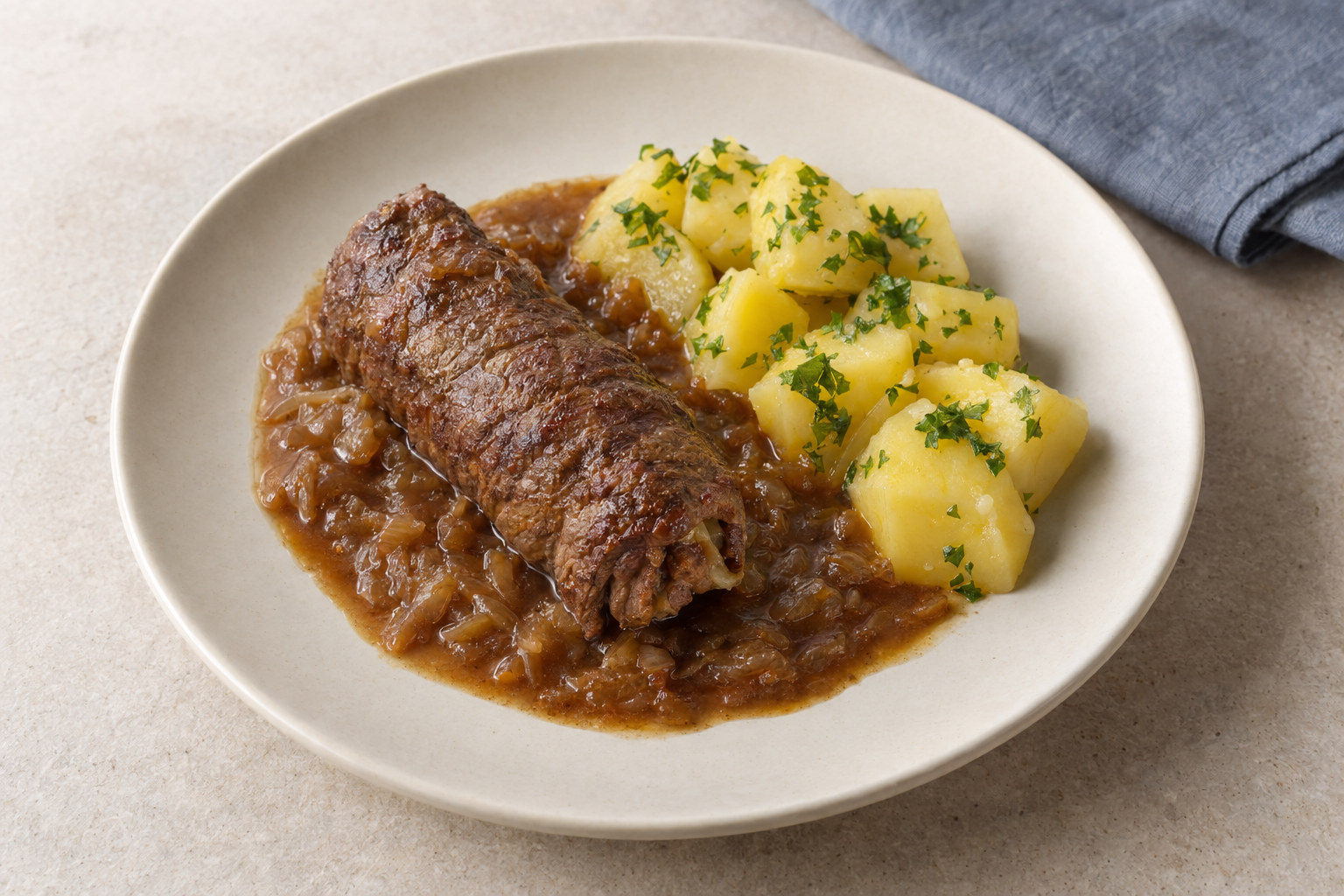
Rich venison haunch wrapped around bacon and a tangy gherkin. Golden-brown onions lend sweetness to the gravy, and the boiled potatoes soak up its full flavour.
Step-by-step method
What you will need
- kitchen scales
- thin-probe food thermometer
- knife and two separate chopping boards
- measuring jug
- heavy 20 cm casserole with a lid, at least 3 l
- 2 l saucepan with a lid
- kitchen string
- meat mallet
- cling film for pounding the meat
- electric kettle
- colander
Before we start
We fill and tie the rolls before heating the casserole. We brown both at the same time. We start the potatoes once the meat is almost tender when checked; they need about 30 minutes including bringing the water to the boil. If the braising takes longer, we keep the potatoes covered and warm them through briefly before serving.
Fill and roll the meat
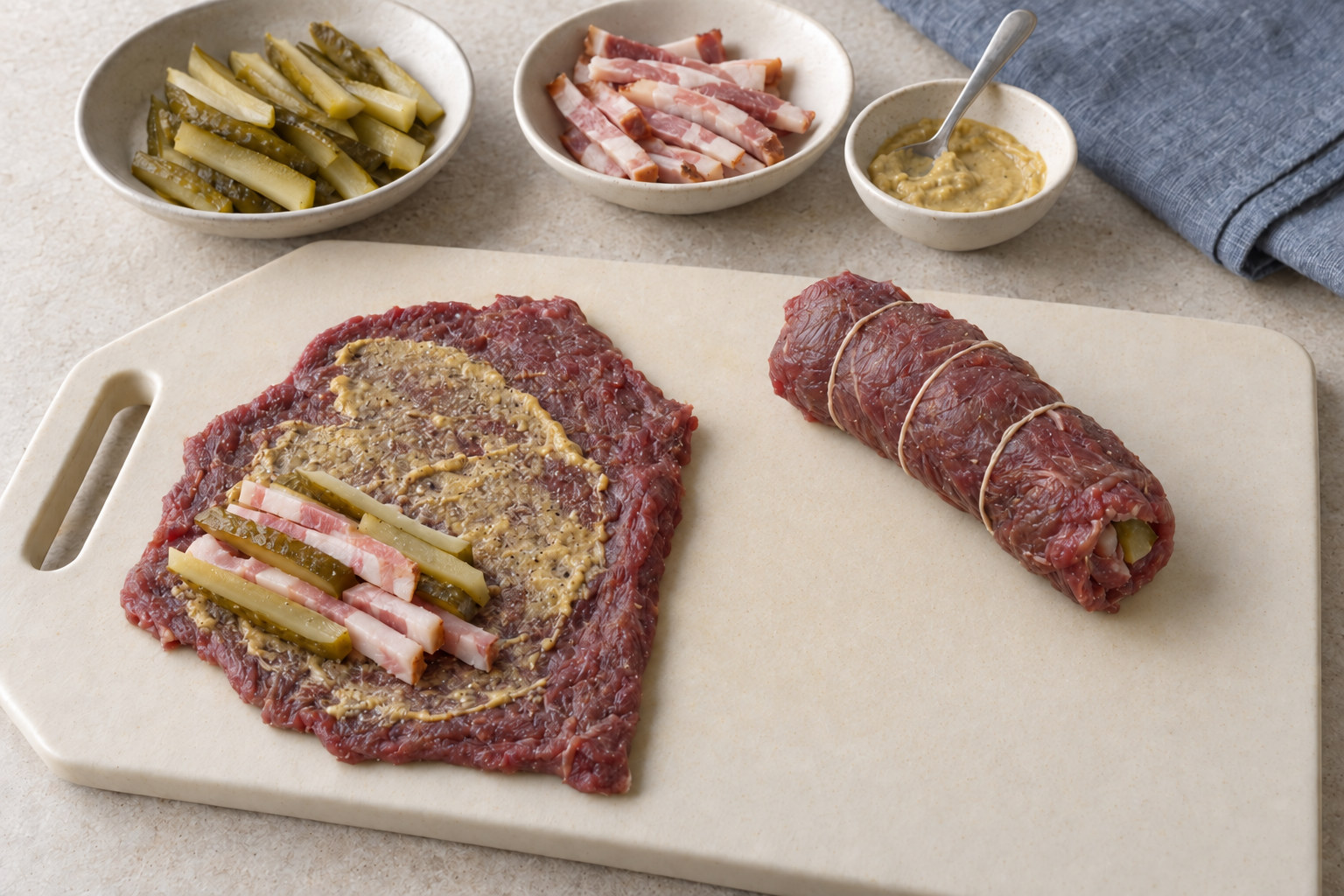
We cut the haunch into 2 wide slices of approximately 210 g each. Between sheets of cling film, we pound them to about 5 mm thick; each slice must be wide enough to enclose the filling. We season with half the salt and the pepper, then spread with mustard. We cut the bacon and gherkins into batons and divide them evenly between the slices. Starting at the shorter edge, we roll up the meat, tuck the edges in and tie with string.
The filling stays inside and each roll is roughly the same diameter along its length.
Brown the rolls and onions
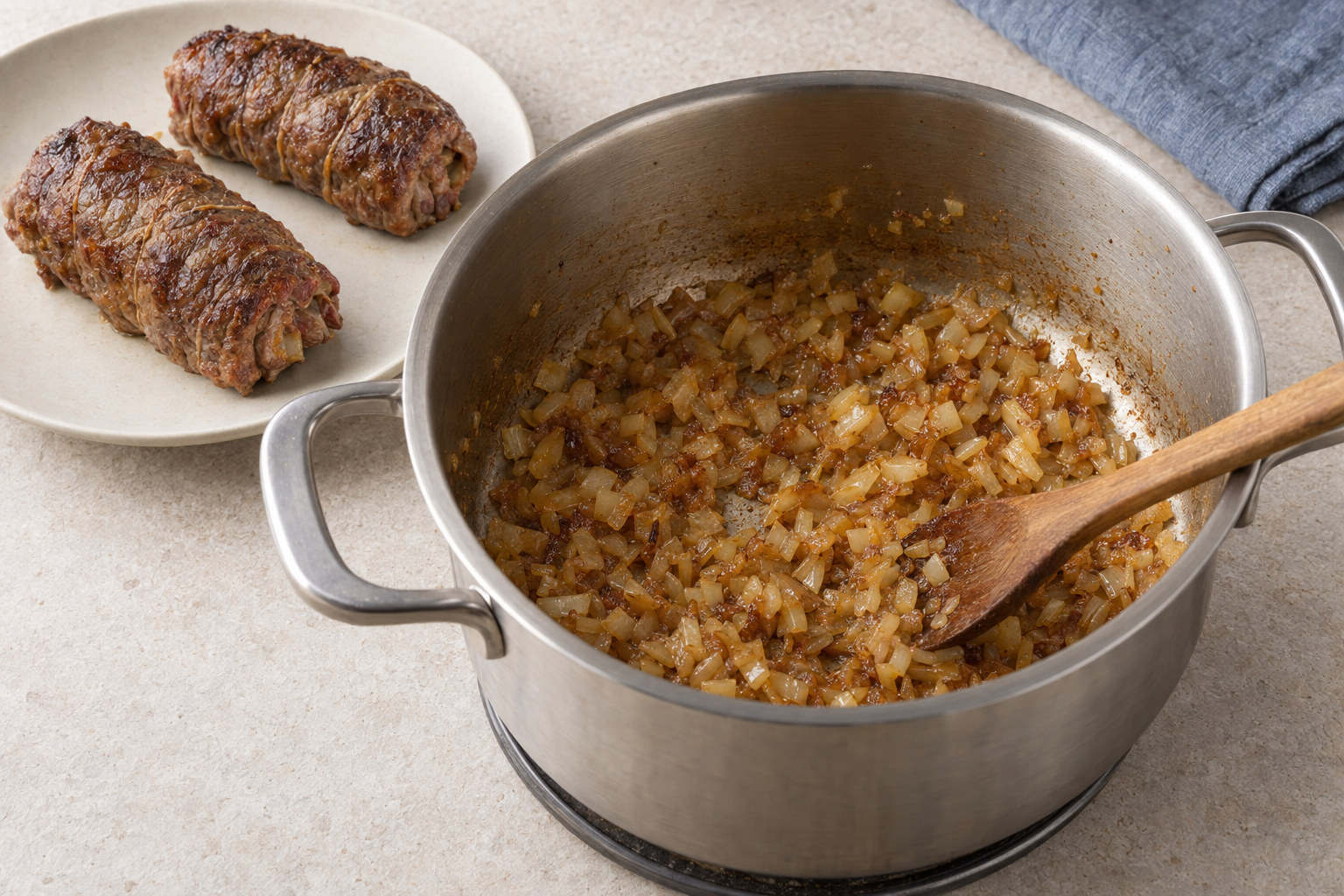
We heat the oil in the heavy casserole. We brown both rolls on all sides for 6–8 minutes in total, then lift them out. We peel and finely chop the onion, then cook it in the same casserole, stirring, for 10–12 minutes until a deep golden colour. We sprinkle in the flour and stir for 1 minute.
The onion is golden-brown with no blackened pieces, and there is no dry flour left.
Braise gently
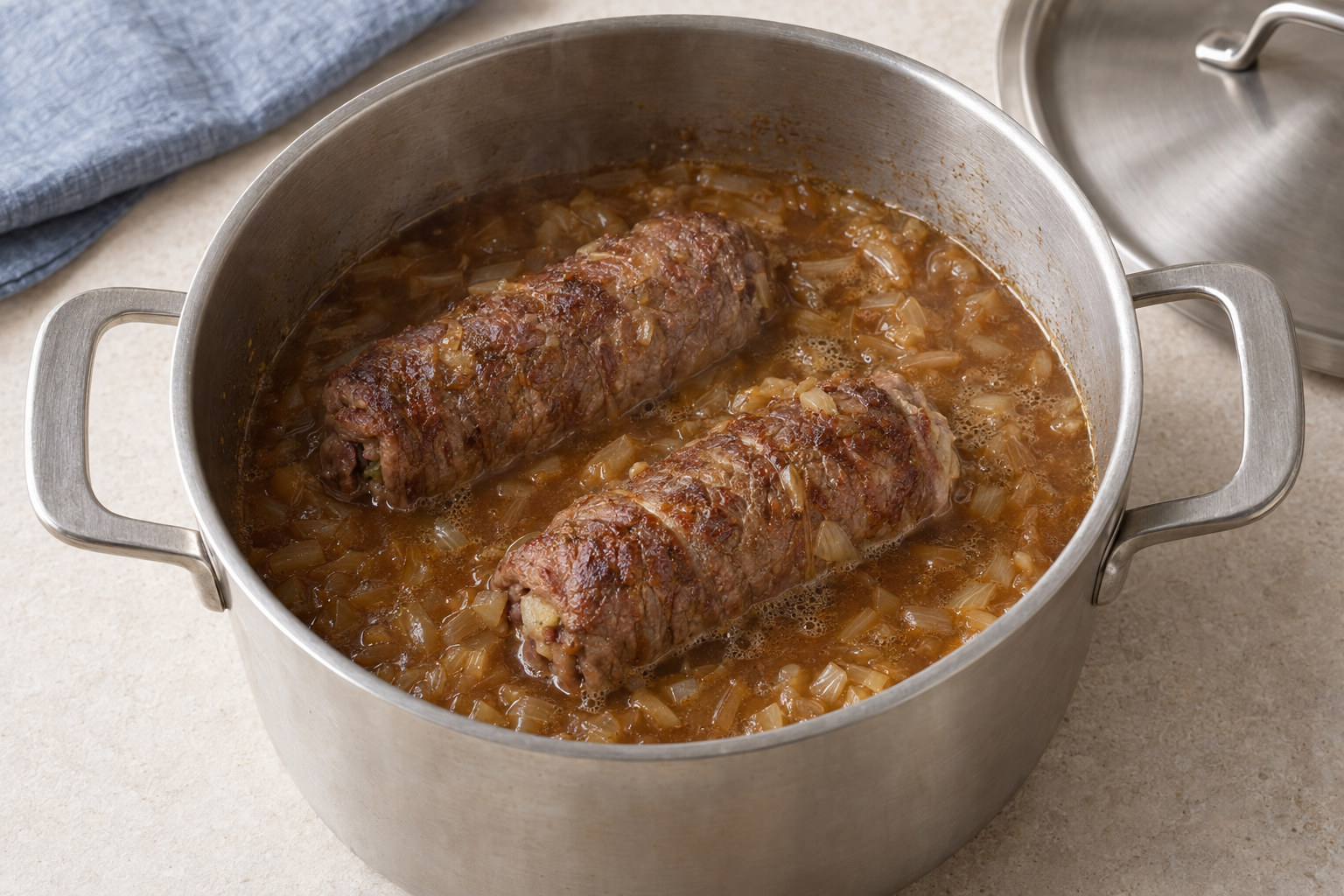
We pour in the stock, stirring, add the remaining salt and return the rolls to the casserole. The liquid should come about two-thirds of the way up them. We cover and braise at a very gentle simmer for 70–110 minutes, turning halfway through. We top up with a little hot water as needed and do not let the bottom dry out. The cooked meat must be fork-tender. With a clean, thin probe, we check that even the centre of each roll and its filling stays at a minimum of 70 °C for 2 minutes.
The stock barely simmers. The roll is tender but does not fall apart.
Boil the potatoes
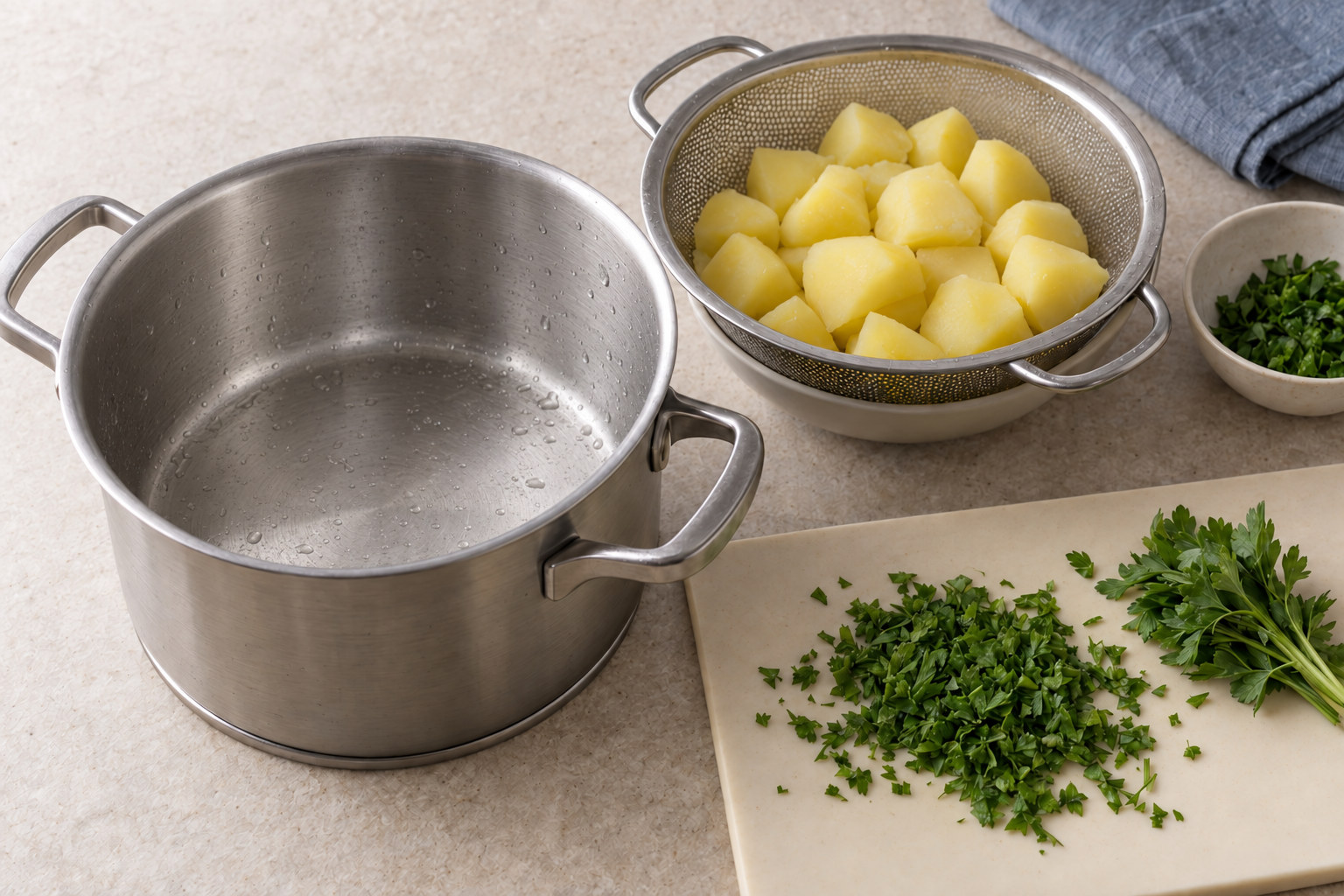
When the meat is almost tender, about 30 minutes before serving, we peel the potatoes, cut them into evenly sized pieces and put them in a saucepan. We add enough salted water to cover them. We bring to the boil, then cook for 15–20 minutes until tender, drain and leave to steam dry for a minute. We rinse, dry and chop the parsley.
A knife passes through the centre without resistance and the potatoes hold their shape.
Remove the string and serve
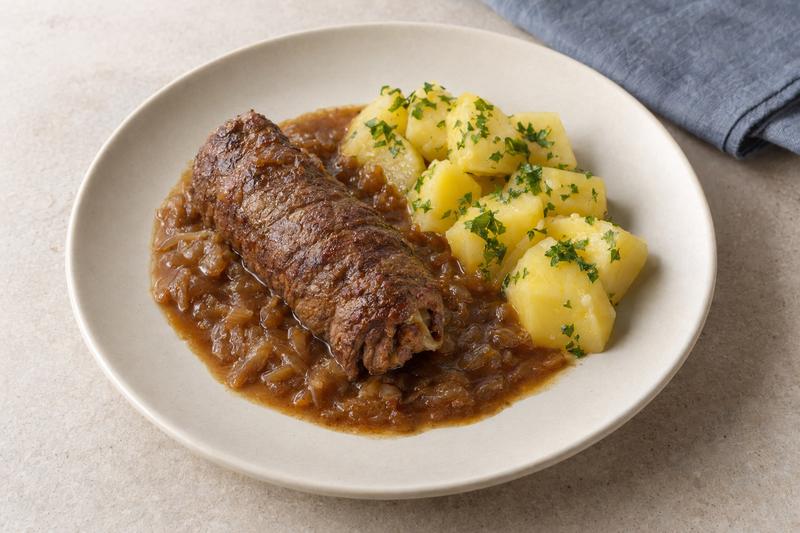
We remove all the string from the tender rolls. If needed, we boil the gravy uncovered for 3–5 minutes to thicken it slightly. We divide the rolls and potatoes between plates, spoon over the gravy and scatter with parsley.
The gravy stays glossy and pourable.
Tips from our kitchen
- We roll the meat firmly but do not tie the string too tightly. We remove all the string before serving.
- We cook the onions until golden, without blackened edges; they flavour and thicken the gravy.
What to watch out for
- A slice that is too thick is difficult to roll and can be tough. We pound it to an even thickness.
- A fierce boil or a dry pan can dry out the lean haunch; we keep the liquid at a gentle simmer.
How we serve it
- We serve the rolls with boiled potatoes, onion gravy and chopped parsley.
Ingredient swaps
bacon
the same weight of ham, plus a teaspoon of butter for two servings or two teaspoons for four servings We add the butter when frying the onions. The filling will be less smoky and less fatty; we do not add any extra salt. The butter adds milk as an allergen.
During preparation
- We keep raw meat and the utensils used for it separate from cooked food. With a clean, thin probe, we check that the rolls reach at least 70 °C for 2 minutes, including the centre of the filling; the meat must also be fork-tender.
Our inspiration
In a meat roll, some of the flavour is tucked away inside. Bacon brings fat, the gherkin adds tang and mustard draws those two bold flavours together; each slice reveals where they sit. We wrap this familiar home-cooked combination in venison haunch. It is a different way of cooking the meat from a ragout: after a slow braise, we keep the rolls whole and save the surprise for the plate.
Similar recipes
Recipe for 4 people
Step-by-step method
Before we start
We fill and tie the rolls before heating the casserole. We brown the four rolls in two batches of two, allowing 6–8 minutes per batch. We start the potatoes once the meat is almost tender when checked; they need about 30 minutes including bringing the water to the boil. If the braising takes longer, we keep the potatoes covered and warm them through briefly before serving.
Fill and roll the meat
We cut the haunch into 4 wide slices of approximately 210 g each. Between sheets of cling film, we pound them to about 5 mm thick; each slice must be wide enough to enclose the filling. We season with half the salt and the pepper, then spread with mustard. We cut the bacon and gherkins into batons and divide them evenly between the slices. Starting at the shorter edge, we roll up the meat, tuck the edges in and tie with string.
The filling stays inside and each roll is roughly the same diameter along its length.
Brown the rolls and onions
We heat the oil in the heavy casserole. We brown the rolls on all sides in two batches of two, allowing 6–8 minutes per batch, then lift them out. We peel and finely chop the onions, then cook them in the same casserole, stirring, for 10–12 minutes until a deep golden colour. We sprinkle in the flour and stir for 1 minute.
The onion is golden-brown with no blackened pieces, and there is no dry flour left.
Braise gently
We pour in the stock, stirring, add the remaining salt and return the rolls to the casserole. The liquid should come about two-thirds of the way up them. We cover and braise at a very gentle simmer for 70–110 minutes, turning halfway through. We top up with a little hot water as needed and do not let the bottom dry out. The cooked meat must be fork-tender. With a clean, thin probe, we check that even the centre of each roll and its filling stays at a minimum of 70 °C for 2 minutes.
The stock barely simmers. The roll is tender but does not fall apart.
Boil the potatoes
When the meat is almost tender, about 30 minutes before serving, we peel the potatoes, cut them into evenly sized pieces and put them in a saucepan. We add enough salted water to cover them. We bring to the boil, then cook for 15–20 minutes until tender, drain and leave to steam dry for a minute. We rinse, dry and chop the parsley.
A knife passes through the centre without resistance and the potatoes hold their shape.
Remove the string and serve
We remove all the string from the tender rolls. If needed, we boil the gravy uncovered for 3–5 minutes to thicken it slightly. We divide the rolls and potatoes between plates, spoon over the gravy and scatter with parsley.
The gravy stays glossy and pourable.